The Consolidation Math: Cutting WordPress Hosting Costs for Agencies

Most agencies do not decide to run one WordPress install per client. It just happens. The first client gets a hosting account and an install. So does the second. By the fortieth, you are logged into forty dashboards, paying forty hosting bills, and running forty update cycles that never quite line up. Nobody chose that overhead. It accumulated one client at a time.
That is sprawl, not scale. Scale means each new client adds revenue without adding a proportional slice of admin work and infrastructure cost. This guide walks through the consolidation math: what the one-install-per-client model actually costs you, what changes when you move the whole portfolio onto a single WordPress install with GrabWP Tenancy Pro, and what you keep after you consolidate.
The Hidden Cost of One Install Per Client
The per-client install feels clean at first. Every client is walled off in its own account, so nothing bleeds between them. But the cost of that isolation is paid in four places, and every new client raises all four:
- N hosting bills. Forty clients on forty accounts means forty line items. Even cheap plans add up, and you rarely get the volume pricing that a single larger environment would earn.
- N update cycles. Every install has its own WordPress core, its own plugin versions, its own security patches. Nobody updates forty sites on the same afternoon, so at any moment some slice of your portfolio is behind.
- N credential sets. Forty logins, forty sets of host credentials, forty places a password can go stale or leak. Onboarding a new team member means handing over a spreadsheet, not a single dashboard.
- N places to look. When a client emails about a problem, you first have to remember which account, which host, which install. The mental overhead of context-switching is real, and it grows with headcount and client count.
None of these costs show up as a single scary number. They hide in your hosting invoices, in the hours your team spends logging in and out, and in the update tasks that quietly slip. That is exactly why they are easy to ignore until margin gets thin.
What Actually Consolidates
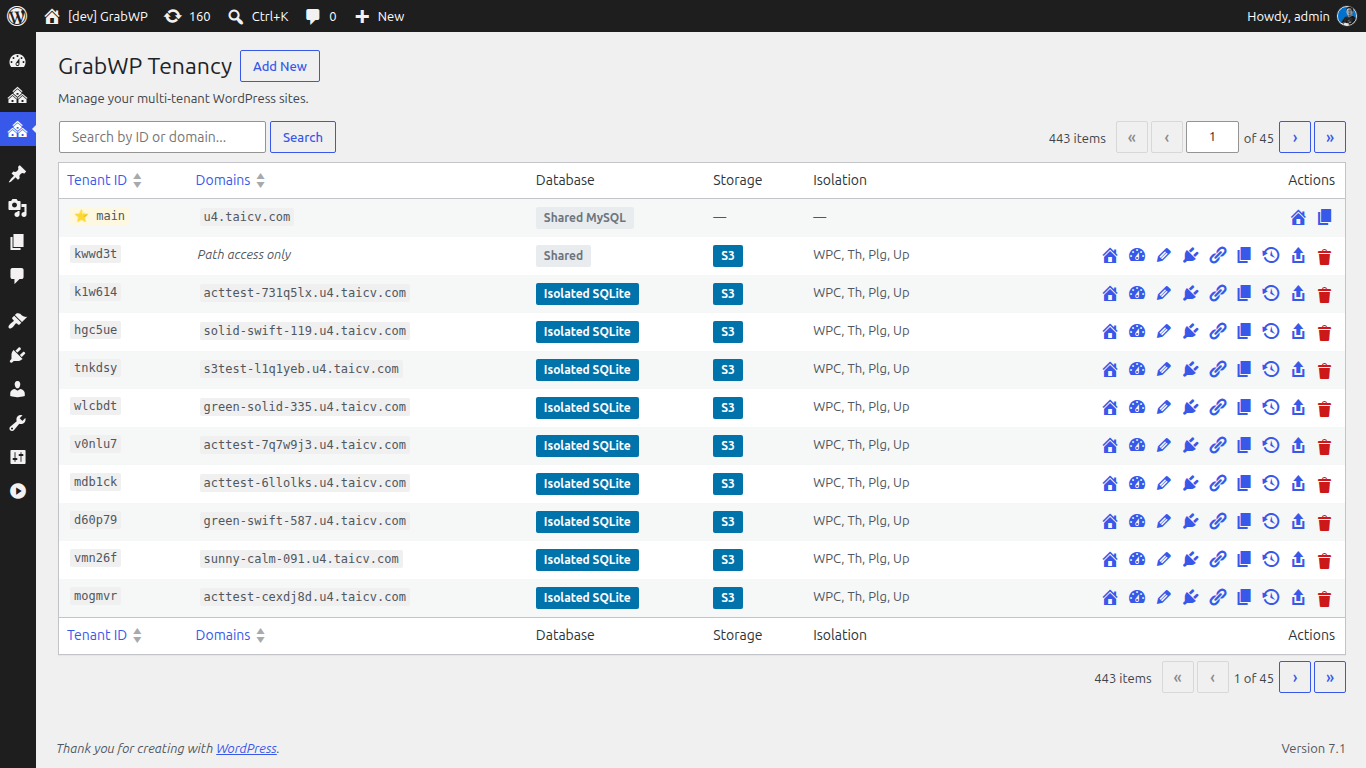
Consolidation here does not mean cramming every client into one shared database and hoping nothing collides. It means one WordPress installation that hosts many isolated tenants, each behaving like its own site.
With GrabWP Tenancy Pro, each client becomes a tenant inside a single standard WordPress install. On the Pro plan each tenant gets its own isolated wp-content directory, so one client can run WooCommerce while another runs a membership stack with zero plugin conflicts. There is no Multisite network involved. You install WordPress once, activate the base plugin and Pro, and every client lives under that one roof while staying walled off from the others.
So the thing that collapses is the infrastructure and the administration: one install to host, one dashboard to log into, one core-and-plugin surface to keep current. The thing that does not collapse is client isolation. That distinction is the whole point. You are removing duplicated overhead, not the boundaries that keep client data separate.
The Licensing Math
Per-client and per-seat pricing is where hosting tools quietly punish growth: every client you win, or every developer you hire, becomes another recurring charge. GrabWP Tenancy Pro is priced the other way around.
Pro is licensed once per WordPress installation. Not per seat, not per client. When you consolidate forty clients onto one install, you hold one license, and your whole team provisions and manages tenants from that single dashboard. Adding client forty-one does not add a license fee. Hiring a second developer does not add a seat fee.
The plan is $9.99 per month, with annual billing at $99.99 and a lifetime option at $499.99. The point is not just the number, it is the shape of the cost. Your licensing cost stays flat as your client count climbs, instead of scaling linearly with it the way a stack of separate hosting accounts does. Combined with folding many hosting bills into one environment, the cost structure shifts from “grows with every client” toward “one predictable line item.”
We will not quote competitor prices or invent a savings percentage here, because your real number depends on your current hosts and plans. The structural change is what matters: one bill and one license in place of many.
What You Keep After Consolidating
The fear with consolidation is always the same: that squeezing everything onto one install means giving up the isolation that made separate installs feel safe. With GrabWP Tenancy Pro you keep the parts that matter.
- Per-client database isolation. Each tenant can use shared MySQL with table prefixes, its own dedicated MySQL database, or a SQLite database. For client work, a dedicated database per tenant gives you genuine separation at the data layer, not just a shared schema with different prefixes.
- Per-tenant backup and restore. Pro gives every tenant its own backup and restore workflow, covering database, uploads, content, and config. You can restore one client to a previous state without touching any other tenant on the install.
- Scheduled automatic backups. On top of manual backups, you can enable scheduled auto-backups with per-tenant retention, so each client keeps its own history on the cadence you choose.
- A stronger compliance story. Because each tenant can run on its own dedicated database with its own backups, you have a real data-isolation architecture to point to when a client asks how their data is separated from everyone else’s.
In other words, consolidation removes the duplicated hosting accounts and admin surfaces, but it does not remove the walls between clients. Each tenant keeps its own data, its own backups, and its own restore point.
How to Start
You do not have to migrate the whole portfolio in one weekend. The consolidation is incremental:
- Stand up one WordPress installation to be your new home base, and install the GrabWP Tenancy base plugin plus GrabWP Tenancy Pro. Activate your single license on that install.
- Set your database default in Pro Settings. For client work, a dedicated MySQL database per tenant is the isolation-friendly choice.
- Move clients over one at a time as a tenant each. Back up a client on its old host, create a tenant for it, and restore into the tenant. As each client lands, retire its old hosting account and cross that recurring bill off your list.
- Once a client is a tenant, capture a baseline backup and set its auto-backup schedule so it is protected from day one.
Each client you move is one fewer bill, one fewer login, and one fewer install to patch. The overhead shrinks as the portfolio consolidates, instead of growing with every new logo.
Consolidate the Overhead, Keep the Isolation
The one-install-per-client model does not fail loudly. It just quietly taxes every client you add with another bill, another update cycle, and another set of credentials. Moving the portfolio onto a single WordPress install with GrabWP Tenancy Pro folds that overhead into one environment and one license, while dedicated databases and per-tenant backups keep each client walled off.
Pro is licensed once per installation, with no per-client or per-seat fees, starting at $9.99/month. See how it fits your team on the agency page, or if you are moving clients over, start with the client site provisioning checklist so every tenant lands the same way.
Tác giả
GrabWP Team
WordPress Multi-Tenancy Experts
The GrabWP team builds and maintains the GrabWP Tenancy plugin, helping developers and agencies run scalable multi-tenant WordPress platforms. With years of experience in WordPress core, hosting infrastructure, and plugin development.
Câu hỏi thường gặp
- Do we pay a license fee for every client we host?
- No. GrabWP Tenancy Pro is licensed once per WordPress installation, not per seat and not per client. You consolidate your whole client portfolio onto one install and run every client as an isolated tenant under that single license.
- Does consolidating onto one install mean sharing one database across all clients?
- Not unless you want to. Each tenant can use shared MySQL with table prefixes, its own dedicated MySQL database, or a SQLite database. For client work you can give each tenant a dedicated database, so consolidation does not cost you data isolation.
- If everything lives on one install, can we still back up and restore one client at a time?
- Yes. Pro gives each tenant its own backup and restore, plus scheduled automatic backups with per-tenant retention. You can restore a single client without touching any other tenant on the install.
- Do we need WordPress Multisite to do this?
- No. GrabWP Tenancy Pro runs on a standard single WordPress installation. There is no Multisite network to configure or maintain.
Editorial standards: Our content is written by WordPress experts with hands-on multi-tenancy experience. Articles are fact-checked and regularly updated to ensure accuracy.